Pocket Keyboard
Initial thoughts
Inspired by artsy pi, it's SO COOL!
A few months ago, a switch on my keyboard started malfunctioning. I've replaced it, but there are now 9 switches left unused and a microcontroller sitting on a shelf collecting dust. That's enough to make a wireless artsey keyboard / macropad with additional external pins for quick hardware projects. It could have the shape of a credit card (or more like a pi model b+) and use the (battery recommendation).
The power switch is completely unnecessary as the controller has deep sleep and the ability to shut down wifi / bluetooth.
Or it could be a gridfinity module like so:
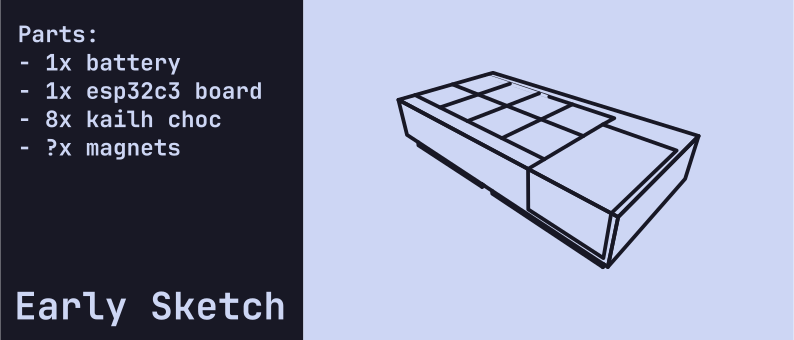
Anyway, the file is artsey.blend
Exploring Different Layouts
I've tried typing "a quick brown fox jumps over the lazy dog" on my keyboard according to the artseyio layout and... I don't really like how much it relies on the pinkies.
There are a few ways to make a layout:
- phonetic. Though I don't think English steno could ever work on 8 keys, there's just not enough keys to cover all the sounds
- orthographic. ET on the thumbs, AO on the middle fingers, IN on the index and SH on the ring, the rest as combos. The easiest combos to hit are for words, for example, "ET" = "the"
I've looked at what else already exists and I don't like those much either. The first stenograph had ten keys, but I guess there's a reason why they have twenty-something now.
https://asetniop.com/ is a thing, but it also requires 10 keys and is not very intuitive, not for me, anyway.
taipo is a thing, but it's very similar to artsey.
Braille would only require 6 keys.
I'm overthinking this, I'll just try artsey and disassamble the project for parts again if it doesn't work.
Wings
I could add a deployable holder for the phone to one side and a pad to hold with your thumb to the other, making a landscape phone dock. Pretty sure that's unnecessary though.
Update:
- Yes, it's completely unnecessary
- There's nowhere I could fit it in a 1x2 gridfinity module
Firmware language?
CircuitPython because it gives me a REPL which is handy for building other projects on top of this one.
Features
- fleeting note inbox when disconnected, combo to then reproduce
- site status control and indication (probably not though)
- bt kb, obvi
- multiple exposed gpio
- circuitpy ws shell so that I don't have to care that webusb works on android and can replace webserial
- a built-in kind-of IDE, see fish-ide
Battery thoughts
The 10x20x30mm batteries I have are small and may work okay. But. But. They are non-standard and I only have 2 and don't know where to get more.
18650 is huge, won't work for a 1x2 gridfinity module. AA is kinda big and I'd need 2 of them. CR2032 works, but they are not rechargable. LIR2032 is the same thing, but rechargable. Settling for them.
I've tried not using a battery holder and designing one from scratch, but honestly it's easier to just use the one I have, even though it's kind of too big.
The general design
I'm opting now (2026-01-29) to not use any screws or glue in the design. The magnets should be embedded in the print, the switches should be press-fit, and the microcontroller should have enough padding with all the wiring and whatnot.
The GCODE stop command that MY printer understands is M25
It's (2026-02-03) and I've modified the middle section to have the magnets glued in and the lid to screw into it. Context: the design consists of 3 pieces
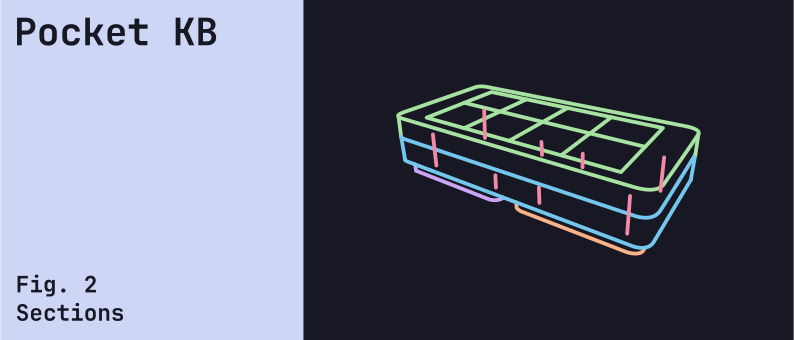
The bottom two, in purple and orange, are the microcontroller housing and the battery holder resepctively. They have a cutout for the part they contain and 4 magnets embedded into the print .8 mm from the top. This is so that the attraction to the middle section of the module is stronger than to the gridfinity base plate.
The middle section (in blue) holds the switches and the wires. It also has magnets, but those are glued in because the section's in the middle and no-one will ever see it anyway, yet making the magnets closer to the other parts makes them stick better. Imagine the magnets as cylinders around the red lines on the sketch.
The top section (in green) is the one that holds the switches from the top, and so it has to be attached securely to the middle. It can't have all 8 magnets because those would be in the way of the keycaps, so it only has 4. To compensate for that, I've added 4 screws to the design. Sure, it looks a bit worse, but it will hold together better.
Scrapping It
I've printed all the parts and they don't lign up. They almost fit, but not quite. So frustrating!
Also I didn't want the screws to be visible and they are now. This makes me want to start from the very beginning.
The fisrt thing I'm doing is ditching the magnets. It's great to have them, but they slow down prototype and don't make for a rigid enough case.
I'll rewrite this section probably this week and add images, so far the redesign is going great. The new thing is simpler, it still has 3 parts, though I'm thinking of splitting it into 4 or 5. Everything is held together with regular M3x15mm screws.
Wiring It
| 6 | 21 | 10 | 9 |
|---|---|---|---|
| 4 | 3 | 2 | 0 |
Software
In the simplest case, I need to remember the down events, save them, then wait until one key is released, then fire that state, then block until all keys are released.
Battery problems
I've hooked it up to a CR2032 and it couldn't even start. Today I've realized that there's a very common type of batteries that I've completely overlooked. Nokia batteries.
I've added an adapter as a new module and...
(not uploading pocket-kb-with-battery-adapter.png, note to self: redraw as svg)
it's way too thick, kinda defeats the purpose. So I'm making a new bottom plate that is no longer gridfinity compatible.
at the end of the day it did end up working, I'll write about it when I have a bit more time.
Project status
The hardware is done, I will try to write more about it and add a 3d model before the end of the month.
The software is coming. Eventually :)